Solar panels on stone and period homes in the Cotswolds
A stone cottage, a Regency terrace or a listed farmhouse can often still have solar panels. The question is usually where they go and how they look, not whether they are possible at all. This guide covers the options most often used on older Cotswold homes and the questions to ask an installer.
Last reviewed 21 October 2026. Sources are listed at the end of this page.
Best place
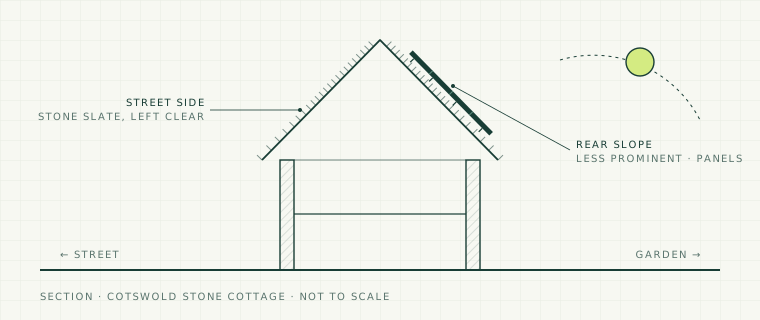
A rear slope
Less prominent slopes are generally acceptable, even on listed homes.
Listed home
Consent always
Listed building consent is always needed for panels on a listed building.
Least noticeable
All-black panels
Black panels with black frames, in a simple shape that lines up with the roof.
What makes Cotswold homes different
Stone slate roofs
Traditional Cotswold roofs are laid in heavy, hand-cut stone slates in courses that get smaller towards the ridge. They are heavier and more fragile than modern tiles, so fixing panels to them takes more care.
Steep, visible roofs
Many older homes face straight onto the street, often with steep pitches that are seen from a distance.
Heritage protection
Many homes are listed or sit in a conservation area or the Cotswolds National Landscape.
Where panels usually sit best
On older homes, the less a panel is seen, the easier the case tends to be. Historic England’s advice for listed buildings follows a similar order, and it’s a useful guide for unlisted period homes too:
1. A rear or less prominent roof slope
Usually acceptable
Historic England says panels on less prominent slopes will generally be acceptable on a listed building, even if they would be visible.
2. A valley roof, or a flat roof behind a parapet
Very little impact
These locations normally have very little impact.
3. An outbuilding
Often a good option
A garage, barn, stable or workshop can carry panels without touching the main house, provided it isn’t more prominent than the house.
4. The ground
Needs care
Panels in the garden avoid the roof altogether, though they still need care in the setting of a listed building.
5. The main roof slope facing the street
Hardest case
This is usually the hardest case. On a listed building, Historic England says panels will generally not be acceptable there.
On-roof, in-roof or solar slates
On-roof panels
How it looks
Panels sit on rails a few centimetres above the existing roof covering.
Things to weigh
Usually the simplest and cheapest option. The brackets pass through the roof covering, which needs care on stone slate.
In-roof panels
How it looks
Panels replace part of the roof covering and sit roughly flush with it.
Things to weigh
A lower, neater profile that some councils prefer. Usually costs more, and part of the roof covering is removed.
Solar slates or tiles
How it looks
Small solar units laid in place of slates.
Things to weigh
Historic England says they don’t usually look convincingly like traditional slates, so they may suit only slopes of low visibility, ideally during a re-roof.
Ask your installer which options suit your roof. Not every installer fits in-roof systems or solar slates, and not every roof suits them.
Making panels less noticeable
Council design advice for conservation areas tends to make the same points:
• Choose all-black panels with black frames, which are less noticeable than panels with silver frames or white backing.
• Use the smallest number of panels that meets your needs, in the least conspicuous place.
• Keep the array a simple shape that lines up with the edges of the roof.
• Run cables discreetly, for example alongside rainwater pipes.
These points come from published council guidance elsewhere in England. Your own council’s advice may differ, so check it.
The roof itself
Panels last for many years, so the roof under them needs to last too.
Condition
If your roof will need work in the next few years, it can be worth doing that first, or combining the two jobs to share scaffolding.
Weight
Historic England says the extra weight of panels on a historic roof needs specialist consideration. Ask your installer whether they will check the roof structure.
Fixings
On stone slate, ask how the brackets will be fixed, how any slates removed will be put back, and who repairs any slates broken during the work.
Weather-tightness and fire risk
Historic England also lists these as points to consider on historic roofs.
Listed homes
Listed building consent is always required for solar panels on a listed building, and doing the work without it is a criminal offence. Historic England’s 2024 advice note covers solar in some detail:
• Panels on less prominent slopes will generally be acceptable, even if visible.
• Valley roofs and roofs behind parapets normally have very little impact.
• Outbuildings or land within the grounds are generally preferable to the main building.
• Grade I and Grade II* buildings may be exceptions, where even less prominent slopes may not be suitable.
It’s worth asking your council for pre-application advice before you apply. A fee may apply.
Questions to ask an installer about a period home
• Have you worked on stone slate roofs or listed buildings before, and can I see examples?
• Which slope or location would you recommend, and why?
• Do you offer all-black panels, and in-roof systems if they would suit?
• Will you check the roof structure and condition before quoting?
• How will you fix the panels, and how will you deal with any broken slates?
• Will you help with the planning or listed building consent application?
FIND OUT MORE ABOUT SOLAR IN YOUR AREA
GOOD QUESTIONS. CLEAR ANSWERS.
Frequently asked questions
A few things worth knowing before you start.
GET STARTED
Own a period or listed home?
Tell us about it and we’ll introduce you to MCS-certified installers serving your area. Mention that your home is listed or in a conservation area, so they can check the options before quoting. There is no cost to you and no obligation.
SOURCES
Where this guide’s information comes from
Last reviewed 21 October 2026. Advice changes, so check the sources below before you act.